Learning self-defence is not about becoming a fighter or looking for confrontation. For beginners, the most useful training often starts with awareness, prevention, communication, and knowing how to get away from an unsafe situation.
Whether you are interested in Brisbane self defence classes for yourself or a family member, choosing a program that teaches practical skills can help build confidence while developing better responses to unexpected situations. Good beginner training should introduce physical techniques gradually while giving equal attention to decision-making and personal safety.
Here are seven essential skills beginners should learn.
Situational Awareness
Situational awareness is one of the most important foundations of self-defence. It means paying attention to what is happening around you and noticing changes that could affect your safety.
This does not mean being constantly afraid or suspicious. Instead, it means staying present rather than becoming completely distracted by a phone, headphones, or other activities.
Beginners can practice awareness by noticing:
- People and activity around them
- Available exits and safe areas
- Changes in the environment
- Unusual or aggressive behaviour
- Places where help may be available
- Whether they are becoming isolated or distracted
Developing this habit can help a person recognize a potentially uncomfortable situation earlier and make a safer decision before a confrontation develops.
Verbal Communication and De-Escalation
Not every conflict needs a physical response. In many situations, calm communication can help prevent an argument from becoming more serious.
De-escalation involves controlling your own response, avoiding unnecessary provocation, and looking for an opportunity to leave safely.
Beginners can learn to:
- Speak clearly and calmly
- Avoid insulting or challenging another person
- Maintain appropriate personal space
- Set firm boundaries
- Avoid escalating an argument
- Look for a safe opportunity to leave
For example, saying “I don’t want any trouble” and moving away can be more useful than continuing an argument simply to prove a point.
The purpose of de-escalation is not to win a confrontation. It is to reduce risk.
Movement and Distance Management
Distance is an important part of personal safety. Understanding how to move, where to stand, and how to create space can give someone more time to make a decision.
Beginner training may introduce basic footwork and positioning so students can become comfortable moving while maintaining balance.
Useful concepts include:
- Maintaining stable footing
- Moving away from potential danger
- Avoiding being trapped in confined spaces
- Keeping enough distance to react
- Moving toward exits or populated areas
- Staying mobile instead of freezing in place
These skills can be practiced without immediately introducing complicated physical techniques.
Basic Defensive Positioning
A beginner should also understand how body positioning can help protect them during an unexpected confrontation.
Defensive positioning is not about standing aggressively. It is about maintaining balance, protecting yourself, and keeping the ability to move.
A good instructor can demonstrate how to position the body while keeping movements controlled and practical.
Students can gradually learn how to:
- Protect vulnerable areas
- Maintain balance
- Keep their hands in a useful position
- Move without crossing their feet
- Create space
- Prepare to disengage
The focus should always remain on safety and escape rather than continuing a confrontation.
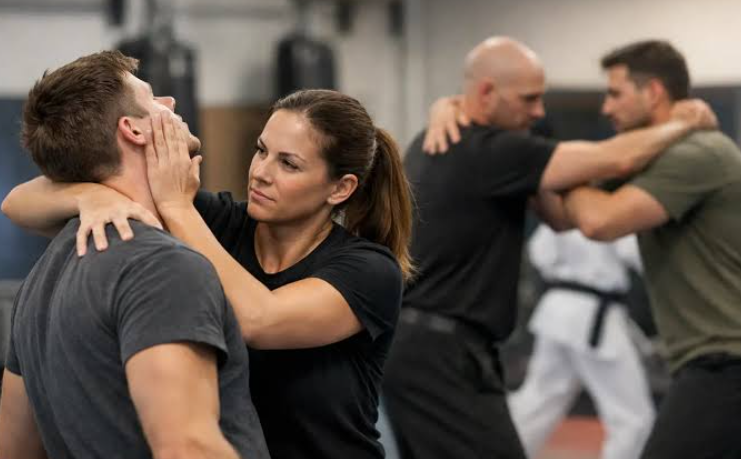
Escaping From Common Holds
Physical self-defence may become necessary when someone is grabbed or physically restrained. For beginners, learning basic escape principles can be more useful than memorizing dozens of complicated techniques.
Training may introduce controlled exercises involving common grabs or attempts to restrict movement.
The main goals are usually to:
- Stay calm.
- Protect yourself.
- Create space.
- Break free when possible.
- Move toward safety.
These skills should be practiced with qualified instruction and appropriate safety equipment. Beginners should not attempt dangerous techniques on friends or family members without proper training.
Basic Striking and Protective Reactions
Once students understand awareness, movement, distance, and avoidance, physical defensive techniques can be introduced.
Beginner classes may teach simple movements that are easier to remember under stress. The purpose should not be to encourage students to fight but to give them options if they cannot safely avoid physical contact.
Training can include fundamentals such as:
- Protective movements
- Basic striking mechanics
- Balance and body positioning
- Creating an opportunity to escape
- Responding to sudden physical contact
Good instruction should emphasize control and responsible use of these skills.
Physical self-defence should generally be considered a last resort when there is an immediate threat and leaving or avoiding the situation is not possible.
Staying Calm Under Pressure
Knowing a technique is one thing. Being able to think clearly when stressed is another.
Fear and adrenaline can affect breathing, concentration, and decision-making. Beginner training can provide controlled practice that helps students become more comfortable responding to pressure.
Students can develop habits such as:
- Taking controlled breaths
- Staying focused on the immediate situation
- Avoiding panic
- Looking for an escape route
- Making simple decisions
- Following practiced responses
This is one reason regular training can be more useful than simply watching self-defence videos. Repetition helps students become familiar with movements and safety principles.
Why Beginners Should Focus on Prevention First
Self-defence is most effective when it helps someone avoid unnecessary physical confrontation.
A beginner should understand that there are many possible responses to a threatening situation. Depending on the circumstances, the safest option may involve leaving, asking for help, attracting attention, complying with a demand involving replaceable property, or contacting emergency services.
There is no single response that works for every situation.
The environment, number of people involved, available exits, and nature of the threat can all affect the safest decision. Queensland Police guidance similarly emphasizes awareness, trusting reasonable instincts, removing yourself from danger, seeking help, and using physical self-defence only when necessary.
What to Look for in Brisbane Self Defence Classes
When comparing Brisbane self defence classes, beginners should look beyond advertising claims and consider what the actual training includes.
A well-rounded program may cover:
- Situational awareness
- De-escalation
- Verbal boundaries
- Movement and distance
- Escape skills
- Basic defensive techniques
- Stress management
- Scenario-based practice
- Responsible use of physical skills
It is also worth considering whether instructors provide a supportive environment for complete beginners. You should not need previous martial arts experience to start learning basic personal safety skills.
A good beginner program should gradually build knowledge rather than overwhelming new students with advanced techniques during their first sessions.
Physical Fitness Is an Added Benefit
Self-defence training can also provide a practical form of exercise. Depending on the class, students may work on coordination, flexibility, balance, strength, endurance, and general movement.
This can make training more engaging for people who find traditional gym workouts repetitive.
However, fitness should support the broader purpose of training rather than replace proper safety education. Being physically fit does not automatically mean someone knows how to manage a dangerous situation.
Confidence Comes From Preparation
One of the biggest benefits beginners can gain from self-defence training is increased confidence.
This confidence should not come from believing that you can defeat anyone. Instead, it can come from knowing that you have practiced useful skills and understand how to respond to different situations.
Training can help students become more comfortable with:
- Speaking up when something feels wrong
- Establishing boundaries
- Moving away from conflict
- Asking for assistance
- Staying aware of their surroundings
- Remaining calm under pressure
These skills can also benefit everyday life by improving focus, discipline, and self-control.
Conclusion
Self-defence for beginners should be about much more than physical fighting. The seven essential skills include situational awareness, verbal de-escalation, movement and distance management, defensive positioning, escape techniques, basic physical responses, and staying calm under pressure.
When considering Brisbane self defence classes, look for training that places prevention and awareness at the foundation while introducing physical techniques responsibly. The strongest beginner foundation is not about learning to fight every problem—it is about recognizing risks early, making sensible decisions, and knowing how to move toward safety when circumstances become difficult.